
Feast of Yahweh in the Millennium: https://www.youtube.com/watch?v=9V6_JmD-zRc&list=PLXqaGD7sX9gb3nByCCGgByiqufuDE8dQt&index=24
Leeland Jones website: https://leelandjones.com/
Leeland Jones video posted on July 15, 2020, transcribed with photos:
{Video begins with Leeland paraphrasing Ezekiel 43:1-12}


“He brought me to the East Gate. And, behold, the glory of God was coming from the east, and His voice was like many waters: and the earth did shine with His glory. And the glory of Yahweh came into the Temple through the East Gate. And the glory of Yahweh did fill the House. And I heard Him speaking to me out of the House.


And he said to me, Son of man, the place of My throne, the place of the soles of My feet, where I will dwell in the midst of the children of Israel for ever, and the place of My holy name.
Now show them the Temple to the house of Israel: show them the design of the Temple:


And measure the pattern. Show them the form and the seat of the House, and the fashion, and the comings and goings. This is the Torah of the House; On top of the mountain the whole limit thereof round about shall be Holy. Behold, this is the Law of the House.”
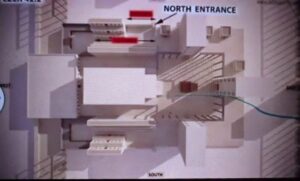




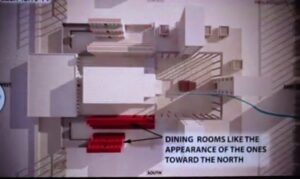

Now as we look at the Feasts of Yahweh, it’s very important that you understand how we got here. Why are we doing this series?
- We’re doing this series because the the apostate Church is for the most part completely ignorant of the Millennium.
- And the fact that the decisions you make day in and day out determine where you will be in the future, in the 1,000 Year Millennial reign of Christ.
That’s why we’re going through these details, we’re showing you what it’s going to be like. Now the reason we’re doing that is because there’s only so much room. When you look at the Temple, you look at the Building, you look at the Dining Halls, I mean, there’s only so much room. There’s only so many people you can fit there.
- And keep in mind these are the Overcomer’s.
- But, these are all the the Saints from old.
They’re all in this Era of Time, because the Resurrection is taking place.
So it’s very important that we look at the Feasts and see why the Feasts are continuing, and what Feasts are discontinued in the Millennium.
- So what the Law First Mentioned means is a principle or something is established. And the Most High gives His order, gives this Way of going about things to establish instruction, establish teaching, establish how do we approach God.
- So the process of the transition to bring us back to the Garden of Eden, is expressed through the Temple, through the Tabernacle.
- Many of you think that you’re Raptured, you go to Heaven, you go to New Jerusalem. That’s not how it works.
- Everything that happened in Exodus is a type and shadow of everything that’s happening in our day, in the 2nd Coming of the Lord Jesus Christ.
- He spoke the 10 Commandments and then He spoke what we’re calling the Law of First Mention.
- You’re gonna win this war by applying the Blood of Jesus Christ to the doorposts of your house. The destroyer is gonna pass over.
- You’re gonna Overcome by Keeping the Sabbath. If you keep the Sabbath then you have the opportunity to enter the Promised Land.
- Yahweh is Alpha and Omega and He instituted these Feasts.
- Those sins Change the original instruction. That’s right, we can see that reflected in the Feasts.
You go Moses. And that’s the same thing you guys are doing. I’m telling you, you can speak to Him, you can hear His voice yourself, you don’t need me, you don’t need anyone else. I’m showing you the pattern, I’m showing you the Way back to the Garden of Eden.
Then we get to Leviticus 23 and we get these instructions for the first time. Then it’s instituted, Sabbath, work six days rest on the seventh day. The Jubilee, essentially, you sow and then you let the land rest in the seventh year. And we get the Feasts.
Now when we get the Feasts, we get the Feasts in Leviticus 23 it says,
- you shall keep the Feast of Unleavened bread,
- the Feast of Harvest or the First Fruits of your labors or the Feast of Weeks,
- and the Feast of Ingathering.
We are instructed on 3 Major Feasts and the Sabbath. This same principle we see in the Millennial Temple and that’s what we’re going to go over in this video, is that these Feasts continue. There are others that are discontinued. Let’s talk about the ones that have been discontinued because this is very important for us.
Remember what happened. You have the golden calf. Then Moses has to go to the mountain another 40 days to intercede for them because God was going to wipe them all out. Then he comes back down with the Tables of Stone again. He’s dealing with the people and they begin to make the Tabernacle. As soon as the Tabernacle is set up, within the seven days, you have the strange fire. What’s the strange fire? Aaron is the priest and he’s got two sons, Nadab and Abihu, and they go into the Temple and they offer strange fire.
When they offer the strange fire then we get the instructions for Yom Kippur. What is Yom Kippur? It’s the one day of the year the high priest could go into the Holy of Holies. We never knew how many times a year he could have done that because there’s a Law instituted that says now you can only do this one time a year because your sons did strange fire.
- Things throughout the Torah are not all the original intention. Yom Kippur is one. Now because of this you can only come one day, a restriction is placed.
Then we get back to the Millennium and now we don’t have this restriction, now the door of the Holy of Holies is open. It’s not one time a year we can see the King, now it’s more. That’s an example of a Law, a Feast even, instituted because of the sins of the children of Israel, because of what they did. Now you can only go into the Holy of Holies one time a year.
- But when Christ came and He sacrificed Himself, that restriction is removed. Now that restriction has been removed. Yom Kippur has no New Testament, after the first coming of Christ, application for us.
Now some people say, Leeland are you Hebrew roots? No, I’m not Hebrew roots. I’ve never been Hebrew roots, because the things I’m telling you they don’t accept.
- They just accept that everything is exactly so but they don’t understand that the sins of the children of Israel affected the Torah. We have to pass the Torah through the Cross, through what Christ did for us on His first coming.
Now as we enter the Millennium we have to do that again, we have to apply the Feast, apply the Torah of the House as you can see in the instruction, into this new era.
- After Christ first coming, after the Cross, you no longer sacrifice a lamb on Passover.
We see the same thing in the Millennium. He completes Himself the sacrifice of Passover. He completes for Himself the sacrifice of Yom Kippur, the Day of Atonement. Those two are completed.
Now another Feast that’s called the Feast of First Fruits, He completed. He completed but we still do it. Why do we do it?
- Because First Fruits is the Resurrection.
Once we get to the Millennium there’s no First Fruits. There’s the Feast of Weeks, yes, but there’s no First Fruits. First Fruits is a single day. It’s the day after the Sabbath during Unleavened bread. That is not in the Millennium. Why? Because it’s memorializing the Resurrection. Christ is the First Fruits of the Resurrection. That Feast continues until it’s fulfilled. When is it fulfilled? It’s fulfilled in the Resurrection. Once we get to the Resurrection, the Feast of First Fruits is fulfilled.
There are 7 Major Feasts and there are 2 Minor Feasts, Hanukkah and Purim.
- Hanukkah is fulfilled. It’s an Apocalyptic scenario that’s also fulfilled in the Apocalypse so that does not continue into the Millennium.
- Purim, that’s the Wedding Supper, that’s the King coming, the revealing of Alpha and Omega. That’s fulfilled.
Now once we enter the Millennium one of the Feasts, we showed you in the previous video, that is every month the East Gate is open and it’s a Feast. It’s a moedim. It’s every month, the first day of every month. That’s instituted. That is a trumpet being blown so that also replaces the Feast of Trumpets. The Feast of Trumpets is not necessarily memorialized with great significance in the Millennium. Why? Because the trumpets of Revelation were blown. Now we go to the other side.
Can you see how the Apocalypse, the plagues that happened to Egypt, the children of Israel went through that Apocalypse, they came out into the wilderness to enter the Promised Land. But they didn’t, only two did, Joshua and Caleb. The story repeats itself in the Apocalypse.
- In the end days, the second coming of Jesus Christ, we have the plagues of Egypt, we have all these Apocalyptic things happen and then you have the Millennial reign. All the things in the pattern of the Sanctuary that Moses sees in those 40 days, we can see in the Millennium.
The major thing in the Millennium is you have 3 Feasts. You have Passover or Unleavened bread. You have Pentecost, the Feast of Weeks, also called Shavuot. If you look this up and you do a search on google and you say what are the Feasts in the Millennium? They won’t include that because it’s hidden, but it’s there. Then you have Tabernacles.
Why do we have Tabernacles? Tabernacles is also a progressive Feast to give us an idea of being a Tabernacle ourselves, being the Temple, and then eventually in the Resurrection receiving the glorified body, but it’s still in the Millennium. Why?
- The final Tabernacles is fulfilled in New Jerusalem where it says, God Himself will be their God, He will dwell, tabernacle with them. That is not fully fulfilled, fully completed, until New Jerusalem. New Jerusalem is AFTER the Millennium.
Then we still have the Sabbath during the Millennium. We have the Sabbath. We have the East Gate being open every Sabbath. We also have the Jubilee. The Jubilee is called the year of release and that’s in Ezekiel chapter 46 and verse 17. It says the year of liberty. That’s still going on so that means that the cycle of seven years and you let the land rest. Then the cycle of the Sabbath of working six days. All that is the same.
Now we have some notes here. We’re going to go through the notes. I really want you to think about how we’re entering these plagues of Egypt. We’re entering this time and these are things that we need to Overcome in this time. That’s why I’m doing this. If you actually understand the message of what we’re doing in this series you can see this is how you Overcome, this is how you are going to deal with what’s going on and things are I think much worse than people realize. We’ll get into that in the future
- But the obvious Feasts that are in the Millennium is Tabernacles, and Unleavened bread. The one that is less obvious is the Feast of Weeks.

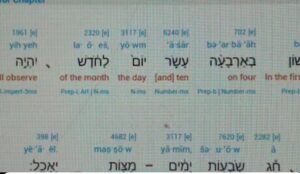
{19:43 min mark} Here’s an app called Bible Hub and in it we can actually see something which is really helpful for us. If we look closely what you’ll notice is it will have the words in English and it will have the words in Hebrew and then the way you say the word in Hebrew. It’s called a trans literation.
We have Ezekiel 45:21 and it says, ‘in the first month on four and ten’, it’s another way of just saying 14, ‘the day of the month you shall observe’, or shall observe you, ‘the Passover’, Pesach. Passover is the Pesach.

Now this is the part that I really want you to pay attention to so as to show you that there’s actually another Feast here that it’s talking about. You can see it says Feast is Hag. That’s the word hag. If you’re in Jerusalem and it’s a Feast time they say Hagsamak. It’s like Happy Holidays. Then you can see the word seven.
Now normally the word seven is Sabbat, but it’s the word for Weeks. In the book of Daniel when it talks about weeks, it’s this word. When it talks about the Hag, Feast of Weeks, this is what it says Hag Shavuot. What it’s saying is Hag Shavuot, this is the Feast of Weeks. Then it says days, yamim.
Most translations in English will say a feast seven days, but this word you would not use this word for seven days, this word is Shavuot. It is the Feast of Weeks. It’s the Feast, Hag of Shavuot, days, yamim. Then it says Unleavened bread. That’s why we’re saying that the Feast of Shavuot, Pentecost, is actually in the Millennium.

{22:50 min mark} Throughout the series I’m going to do my best to provide notes for all the content. I may even go back over some previous messages and have handwritten notes like this. That way you can have a whole pdf file and reference to understand how the progression of the messages is going. It’s makes a lot of sense once you see one message after the next.
{To learn more, please download and study the Feasts.pdf at the bottom of this blog post.}
What we’re talking about here is the Feasts and the Sabbaths in the Millennium. We’re just going to give you some basic words in Hebrew to understand.
You can see Ezekiel has the Temple. When we talk about Ezekiel, we’re talking about Ezekiel chapter 40 through 48 which is talking about the Millennium. There it says the Feast, the hag, and then you have plural of that word hag which is hag-gim and the months, chodesh or chodeshim, and the sabbaths and all the appointed times. Appointed time is singular moed or appointed times is moedim. These are the Feasts.
- When these words are used, hag or moed, these are talking about the Feasts of Yahweh.
{24:15 min mark} If you can see it on the side here it says, Three Times a Year you shall See the Face of Yahweh. Again, your English translations don’t say that. They say you shall appear before. But again if you look at the Hebrew you’ll see raah which means see and face is paniym, face of Yahweh.
- That’s God’s great love and desire is to Feast, to go back to the Garden of Eden with us.
These Feasts are exciting times throughout the year that are Memorialized for a story, for a message. These are the 3 Major Feasts. They don’t go away in the Millennium. They’re Memorialized. They continue.
We have Passover. Passover is also called Unleavened bread. Again, in the time that we are in, the Apocalypse, they Overcame by the Blood of the Lamb.
- It’s the Blood of the Lamb. That’s how we Overcome, Revelation 12:11.
Throughout this we’re going to show because many of the apostate, ignorant Christians have no clue about these Feasts. They say, oh that’s Jewish, that’s the Old Testament, that’s finished!
- So we’re going to show you everything in the New Testament where it talks about the Feasts as well.
Basically what we’re doing in our notes is you’ll see we have red. Red is the Law of First Mention. Red is when Moses was in the 40 days the first time. You can see the verses in Exodus showing that. Then we have green. Green is in the Millennium and that is in Ezekiel. Various verses in Ezekiel chapter 45 talk about these Feasts.
They Overcame by the Blood of the Lamb. The Passover is seen in Exodus chapter 12 which gives you a lot of details.
The purpose of this video is not to tell you every little detail of the Feasts. We have lots of other videos on that. We have a whole playlist on the Feasts. If you have specific questions about the Feast, what about this? What about that? Please reference the playlist on the Feasts & Sabbath. You will more than likely see in the title of the video the answer to your question.
{The link to the Feasts & Sabbath playlist is posted at the bottom of this blog post.}
The Destroyer must pass over. That’s why we’re showing the blood on the doorpost, because that’s the Passover Lamb. He’s been sacrificed for us but you have to intentionally do it. You can’t think Christ just did everything for me.
- There are obvious plagues and things that are happening to Christians because they’re not applying the Blood, they’re not taking seriously the work of Christ. You have to understand these things and apply them to your life.
They shall eat Unleavened bread seven days. This is in the first month on the 14th day of the 1st month, to keep the Passover. Why is it Unleavened bread?
- Unleavened bread means that you remove the leaven, you remove the sin. Christ said the leaven of the Pharisees, the leaven of Herod. You have to remove the sin. You have to remove the false doctrine.
- Every year you do that intentionally evaluating yourself, what kind of false teaching am I following? What is the leaven in my heart that I need to remove?
We see this in Ezekiel 45:21. You shall keep the Passover, the hag Shavuot, yamim, days. Remember we saw that before it’s the Passover but this is a different Feast here, this is the Feast, Hag Shavuot, Feast of Weeks. Then it says Unleavened bread shall be eaten seven days of the Feast or of the Hag.
Now if we go to the New Testament, 1 Corinthians 5:7-8, Purge out the old leaven that you may be a new dough as you are unleavened.
- It is you that has to be unleavened when Christ appears. We must be without spot or wrinkle. We must remove all the leaven and antichrist and false spirit doctrines and everything. We must remove them.
For Christ our Passover is sacrificed for us. Keep the Feast. This is even a command by the apostle Paul but the Christians still don’t do it. They’re still totally ignorant and blinded by the Pope and the Vatican church even though they’re Protestant. They’re supposed to be separate.
- The Protestants never restored the Feasts.
{1 Corinthians 5:8} Unleavened bread of sincerity, or purity, of truth. That’s what you do every year. That’s what you should do, but many of you are not, and that’s why teachings like this are strange to you.
We saw Pentecost, many of the denominations are Pentecostal but they don’t know anything about the actual Feast of Pentecost. Yes, there’s a Feast. It actually happened. It’s called the Feast of Weeks and Shavuot. We saw in the Law of First Mention that it was the Feast, the Hag, of Harvest or Weeks, Shavuot {Exodus 23:16} of the First Fruits of your labours or the wheat harvest {Exodus 34:22}.
Then it says on the Day after the Sabbath during Unleavened Bread you add 50 days. This is in Leviticus 23 when it tells us when the Feast takes place. Penta means 50 and you count 50 days in the Sabbath that’s during the Feast of Unleavened Bread, you count 50 days to come to this Feast. It’s called the Feast of First Fruits.
These are the First Fruits in Ezekiel 44:30, and this is the 144 000 in Revelation 14:4. They are First Fruits. You shall keep the Passover, the Feast, Hag Shavuot, of Weeks. This verse here {Ezekiel 45:21} is talking about two different Feasts, you have Passover and the Feast, Hag, of Shavuot, Weeks. Unleavened bread shall be eaten seven days.
What this means is that this is a Change. In the Millennium, Unleavened Bread is eaten the seven days of Shavuot. Now normally in Leviticus 23:17, in the Torah, the bread that was eaten was leavened. There was leaven bread, there was yeast in the bread. That was the ordinance at that time.
- But in the Millennium that changes, and it’s Unleavened Bread that is to be eaten.
Again, Pentecost was kept by the Apostles. It’s the day the Church, Ekklesia, began in Acts chapter 2. Paul also kept the Feast of Pentecost or at least attempted to get to Jerusalem for Pentecost. He describes that in Acts 20:16 and 1 Corinthians 16:8.
- We’re just pointing out that the early Church did Keep the Feasts.
Then we have the Feast of Ingathering or called the Feast of Tabernacles or Sukkot. A tent or a booth is a sukka and plural is sukkot. It’s called the Feast of Ingathering at the year’s tekuphah or the bringing out. We showed you in the previous video how the tekuphah is the Fall Equinox, and so this Feast should be close to that. It’s called Tabernacles or Sukkot and we see that in the Millennium.
In the Millennium, in the 7th month and the 15th day of the month at the Feast, Hag, of seven days. All of these Feasts are seven days long.

{32:22 min mark} Then we get to the Sabbaths. We’ve seen the Feast of Passover, Feast of Shavuot, the Feast of Ingathering.
I didn’t read this, this is really important. In the Millennium it says, all nations shall go up and worship the King, melech, Yahweh Sabaowt. This is the Lord of hosts. They’re going to worship the King, the Lord of hosts. To keep the Aleph Tav Feast of Tabernacles.
- This is making it clear that the Feast of Tabernacles is going on during the Millennium. This is Zechariah chapter 14 verses 16 through 19.
Now I want you to notice I’ve put some things here that are really important for us to understand.
- It is Christ who is both the King. It says Jerusalem is the place of the King and He is Yahweh. He is Yahweh Sabaowt. It says to keep Aleph Tav, remember how He’s Alpha and Omega in the Greek in the book of Revelation, well this is an untranslated word, an Aleph and a Tav, and it comes right before Hag, Feast.
- So it’s the Aleph Tav Feast. It’s not a Jewish feast, it’s Yahweh’s Feast!
Not only that, Alpha and Omega is Yahweh. He is the King, He is Yahweh Sabaowt. They will keep the Aleph Tav, Alpha and Omega Feast. I think that was just three languages all at once. The Feast of Tabernacles, Sukkot.
Now the nations. It’s amazing during the Millennium the nations still won’t listen and obey everything.
- If you don’t obey God, if you don’t listen, you don’t prepare, it means you’re going to be in the outskirts of the kingdom.
For example, you might be an American, you may not prepare yourself for the Millennium and you may end up in Egypt because then it says there are people in Egypt and they won’t come for the Feast, and so they’ll be subject to a plague. There’ll be no rain. We don’t want to be in Egypt. We don’t want to be in Ethiopia. We don’t want to be in India. We want to be close. We want to be in the Promised Land but it’s telling us, the instructions are telling us that there are people that still won’t obey God even though the devil is incarcerated for a thousand years. There are still plagues. There are still people that will not obey Yeshua. It’s amazing.
Then the Sabbath continues and as we told you the Sabbath is in the Law of First Mention where we talked about when He came down on Mount Sinai. The Sabbath is in the 10 Commandments, the fourth commandment, Keep the Sabbath. Six days you shall work and the seventh day shall be a rest. Then it says, you shall keep for a Sign.
- Some people say that the Sign of the Sabbath, this is our protection. This is the Sign, even the Sign on the forehead.
It talks about this Holy Sabbath Sign in Ezekiel chapter 20. Ezekiel chapter 20, I’m just going to reference here, but it talks about some of the things we’re mentioning where some of the Laws were instituted based on their sins.
- It says that they did not enter the Promised Land because they polluted the Sabbath. That’s Ezekiel chapter 20 verse 16.
As well, the whole book of Hebrews, I forget if it’s Hebrews chapter 3 or chapter 4, it talks about how they entered not because of unbelief.
- The Christians are doing the same behaviour as the Jews. You can read in the Old Testament, it’s all the same. It’s same idolatry, same disobeying. Everything is the same. Many are not going to enter the Promised Land.
When it talks about the Promised Land that is a specific territory, specific area, around the size of modern day Israel. It’s a little bigger than that but approximately. How many people can you fit in that? You see what I’m saying. That’s why people are going to end up in Egypt and Ethiopia and India, the outskirts. Why? Because they polluted the Sabbath.
Remember in the Millennial Temple the East Gate is open on the Sabbath and the people shall worship Yahweh {Ezekiel 46:3}.
- Then again in the New Testament Christ admonished us, Pray that your escape be not in the winter nor on the Sabbath {Matthew 24:20}. Why is the Sabbath day important? This is written to Christians.
There are some Christians, there are some believers in Yeshua that are keeping the Sabbath. There’s a woe to them, or pray that you don’t make your escape on the Sabbath, because we don’t want to break the Sabbath. That’s Matthew chapter 24 and verse 20.
In addition to that the seven year shmita or the seven year cycle of letting the land rest and the Jubilee will also be instituted in the Millennium. It’s called the Year of Liberty in Ezekiel 46 verse 17 and part of the Law of First Mention in Exodus 23 verse 10.
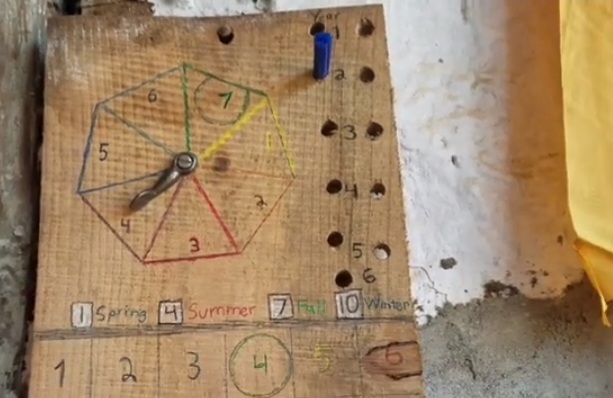
{38:24 min mark} Now we also want to show you at various points what time it is in the Enoch calendar. First you must know the day of the week. It is the fourth day of the week. The fourth day of the week is a Wednesday. We are still in the fourth month. The fourth month is where you have typically the Summer Solstice and we’re coming to the close of the month, we’re at the 29th day of the fourth month.
And just to explain where the Feasts are. In the first month, in the Spring, the 1st month on the 14th day, of the first month is Passover. Passover is the 14th day. There’s a Sabbath here (18th day) and then this is First Fruits (19th day).
It’s from this day you count 50 days. You can also count the Sabbaths, one, two, three, four, five, six, seven. Then the next day is Shavuot or the Feast of Weeks. That takes place in the 3rd month and the 8th day. The 8th day of the 3rd month is the Feast of Weeks.
Then we have the 7th month and the Feasts there.
This is part of our playlist on Show Design, Measure Pattern. We’re doing this as a study to look at the future 1000 year reign of Christ in the Millennium. But not only that, how do we enter Rest as it says in Hebrews. How do we enter the Promised Land? How do we enter that promise? We’re going to go through more details.
Please watch the two previous videos. We spent so much time to explain the structure of the Temple itself as a Sundial, as a Calendar so that these Feasts that we’re going over we would be on the right time.
- You can see certain things in it that you will not find if you follow the moon.
All the moon people I ask you, look at the Temple and show me 3 witnesses in the Millennial Temple that prove your moon calendar. I know one, and that’s all you’ll find. You won’t find any numbers. You won’t find any of it. We’re on the right calendar.
These are the Feasts and we’re doing this to enter Rest, enter the future. It is Christ He has opened the door for us into the Temple. He said, I’ll make you pillars in the temple. You’ll no more go out.
I’m doing this so that you understand. It is the Blood of the Lamb, the Blood of Christ, that will defeat anything that’s going on in the world. Amen.
Please watch the playlist and as we say, Fear God, give glory to Him for the hour of His judgment is come. Worship Him that made the heavens, the earth, the seas and the fountains of waters. Amen.
Leave a Reply